

Setting up backups should be the easiest part of managing your infrastructure. But if you're honest about it, it usually isn't.
You spin up a new VPS. You deploy a few projects. A database here, a storage bucket there. Before you know it, you've got 20 resources scattered across your stack, and setting up backups for each one means manually figuring out what's running, what technology it uses, what to include, what to exclude... and repeating that process for every single resource.
We've watched this pattern play out with thousands of SimpleBackups users. And we kept asking ourselves the same question: why should you have to tell us what to back up when we can figure it out for you?
That's exactly what Stack does.
What is Stack?
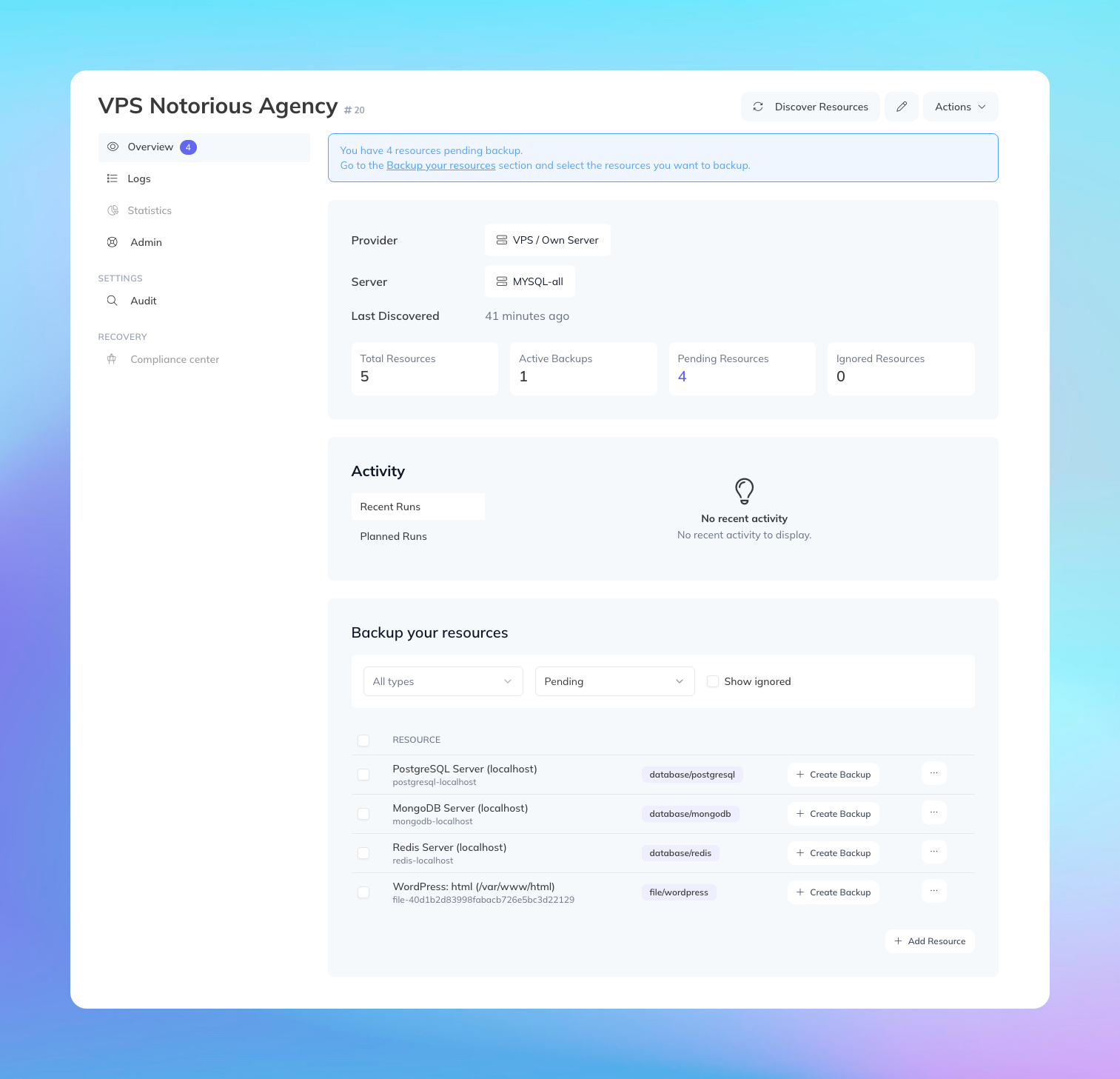
Stack is a new way to manage backups in SimpleBackups. Instead of creating backups one by one, you connect your infrastructure (a VPS, a Kubernetes cluster, a cloud provider) and Stack automatically discovers every resource that needs backing up.
It then suggests the right backup configuration for each resource, pre-filled and ready to go. You review, adjust if needed, and create them in bulk. Done.
The key part: you still make every decision. Stack doesn't create backups behind your back. It identifies what's there, suggests what makes sense, and lets you take it from here.
How it works in practice
Scenario 1: You have a VPS with multiple projects
You connect your server. Stack scans it and finds 20 projects. Different frameworks, different databases, different file structures. For each one, it identifies the technology, the database engine, the files that matter. It then generates a backup template for each project, pre-configured with the right settings.
Instead of spending an afternoon setting up 20 individual backups, you review the suggestions and bulk-create them in a few clicks.
Here's the part we're really excited about: let's say next week you deploy a 21st project. Stack detects it, alerts you, and you set up that backup in seconds. No more "I forgot to add backups for that new app."
Scenario 2: You're a Supabase customer
You've got multiple databases and S3 storage buckets across your Supabase account. Connect it to Stack, and it discovers all your Supabase resources automatically. You then bulk-create backups or replication jobs for everything. Whenever you add a new database or bucket, Stack lets you know it's there and probably needs a backup.
This works the same way for other providers we're rolling out support for, and we're adding more as we go.
Why we built this
If you've been with us for a while, you might remember what we used to call "full backups", the ability to combine file and database backups into a single job. It was one of our most-requested features and did the job for straightforward setups.
Stack is the natural evolution of that idea, but it goes much further. It's not limited to files and databases on a single server. It works across providers, across technologies, across your entire infrastructure. Including Kubernetes.
Our thinking is simple: a backup solution that feels smooth, intuitive, and natural to use will lead to better backup coverage. When it's easy to set things up, nothing gets left behind.
We've always believed that the biggest risk in backups isn't a failed job — it's the backup you never created in the first place. Stack is our answer to that.
What's in the beta
Stack launches today in beta with support for:
- VPS / Servers: auto-discover projects, databases, and file structures
- Kubernetes clusters: discover workloads and persistent volumes
- Cloud providers: connect and discover resources across your accounts
- Supabase: databases and storage buckets
We're actively expanding provider support and would love your input on what to prioritize next.
Try it out
Stack is available now for all SimpleBackups users. Head to your dashboard, connect your first stack, and see what it discovers.
As always with a beta, we're iterating fast. If something feels off, if you have ideas, if a provider you rely on isn't supported yet — tell us. That's exactly how we build.
Your feedback during this beta will directly shape where Stack goes next.