

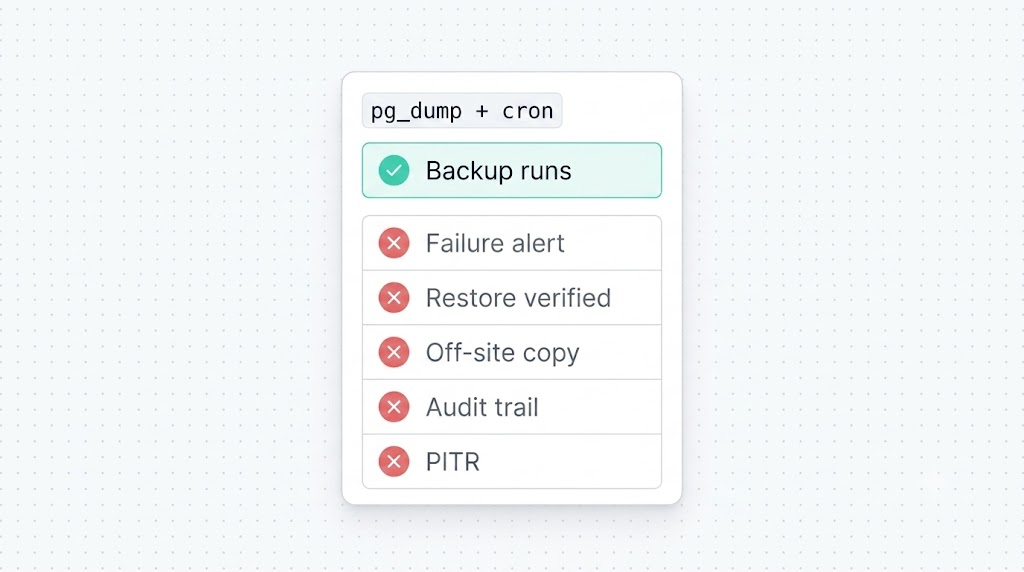
Most pg_dump + cron scripts pass exactly one test: does the command run without erroring. That is the wrong test. The one that matters, does the backup restore, usually goes unanswered until the day you need it. This guide walks through what to replace that script with, and when each option is actually the right call.
The Best pg_dump + Cron Replacement, Honestly
The best replacement for a pg_dump + cron script depends on what the script actually fails at. For most teams, the failure is operational: no alert when the backup breaks, no off-site copy, no proof the last backup restores.
The off-site gap is the one worth closing first, because it is the cheapest and it is the only one that survives losing the database host. Sending PostgreSQL backups to S3 is the short version if you want to fix that today and leave the rest of this article for later.
For that failure mode, a managed Backup-as-a-Service is the practical answer. SimpleBackups triggers, schedules, automates, and monitors PostgreSQL backups for 3,200+ teams with zero overhead.
If the problem is specifically capability, meaning point-in-time recovery on a large self-hosted cluster, physical tools like pgBackRest or WAL-G are the right layer, though you'll own the operational complexity.
Worth knowing before you decide: those are different categories, not competing options.
What Is Backup-as-a-Service for PostgreSQL?
Backup-as-a-Service (BaaS) is the operational layer that automates, monitors, and proves the restorability of PostgreSQL backups without you writing or maintaining scripts. A managed BaaS replaces the cron-and-dump pattern with a control plane that handles scheduling, compression, encryption, off-site storage, retention policies, and failure alerts. It surfaces all of it from one place, not a separate script per database engine.
Here's the distinction worth knowing. pg_dump produces logical backups: a portable export of a database's objects and data. It's the right tool for migrations, selective restores, and small databases. What it can't do is point-in-time recovery (PITR), because that requires WAL archiving and physical backups.
If your scenario requires PITR, that's a separate decision from whether to replace your cron script. Physical backup tools (pgBackRest, WAL-G, Barman) address that requirement, at the cost of operational complexity you own.
Who Should Replace Their pg_dump + Cron Script?
This guide is for DevOps engineers, SREs, and technical founders running production PostgreSQL, whether on Linux servers, managed instances, or private VPCs, whose current backup setup is a pg_dump script that hasn't been tested in production.
You're likely in the audience if any of these are true:
- The last backup ran with no error but you haven't verified a restore.
- Backups land on the same cloud account as production.
- A cron failure sends no alert.
- You're facing an ISO 27001, SOC 2, or HIPAA audit that asks for documented backup procedures.
- You're adding a new database engine or SaaS app and the script doesn't cover it.
If you need PITR on a 100GB+ self-hosted cluster and have the engineering capacity to operate a physical backup system, the comparison section below starts with that scenario.
5 Things to Evaluate Before Replacing Your Backup Script
- Failure alerting. When a backup fails silently, you find out at restore time. Any replacement needs to notify you before an incident does.
- Restore verification. The question isn't whether the backup ran, it's whether it restores. These are different tests. Your replacement should answer both.
- Off-site storage. Backups stored on the same provider as production are not protected against account suspension, breach, or provider migration. Off-site is the point.
- Encryption with key ownership. Who encrypts the backup and who holds the keys? Third-party tools that see backup data in transit are a non-starter for most security reviews.
- Point-in-time recovery.
pg_dumpcan't do PITR. If your scenario requires it, you need WAL archiving and a physical backup tool. That's a different evaluation from this one. - Audit trail. ISO 27001, SOC 2, and HIPAA auditors ask for documented backup procedures, retention logs, and encryption evidence. A cron script produces none of this.
Where SimpleBackups Fits in the PostgreSQL Backup Stack
SimpleBackups is the managed BaaS layer. It is the right answer when the problem with your pg_dump + cron setup is operational, not architectural.
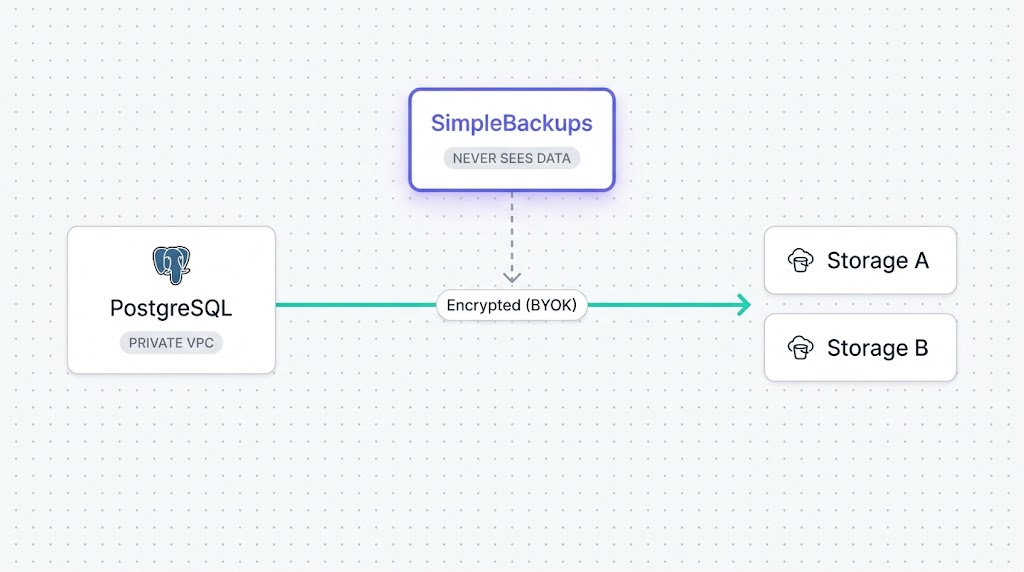
Here's what it covers that a pg_dump + cron script doesn't:
- Backup failure alerts, so you know before an incident does.
- One control plane for PostgreSQL, MySQL, MongoDB, Redis, servers, and SaaS, not a separate script per engine.
- End-to-end encryption. Backup data flows server-to-storage directly. SimpleBackups never sees or stores it. AES-256 encryption with your own private key (BYOK).
- 3-2-1 enforced across providers with off-site replication, so backups survive provider account issues.
- ISO 27001 certified since 2023, audited annually. Audit exports covering retention, encryption and restore history, which is what ISO 27001 and SOC 2 reviewers ask for.
- One-command restore from the CLI, REST API, and native MCP server.
- Firewall and private VPC support, with no inbound ports required.
Worth saying plainly: SimpleBackups uses logical backups. If your scenario specifically requires physical backups and PITR on a large self-hosted PostgreSQL cluster, pgBackRest or WAL-G are the appropriate tool. The comparison section below draws that line clearly.
Managed BaaS vs Self-Managed Tools: Drawing the Line
The tools that come up most when people replace pg_dump + cron are pgBackRest, WAL-G, and Barman. Here's the honest framing.
pgBackRest, WAL-G, and Barman are self-managed physical backup tools for PostgreSQL. They give you things pg_dump can't: incremental backups, WAL archiving, and true point-in-time recovery. They're production-grade for large clusters.
The trade-off is real. You install, configure, monitor, and maintain them. pgBackRest has no built-in scheduler, so cron or systemd timers are still how you trigger it. Adding a new database engine, storage provider, or compliance requirement is maintenance you own.
SimpleBackups is a different category: a managed service where scheduling, monitoring, alerting, encryption, retention, and restore verification are the product, not things you configure. Backup data flows server-to-storage directly, and SimpleBackups never sees it. One control plane covers PostgreSQL, MySQL, MongoDB, Redis, servers, and SaaS.
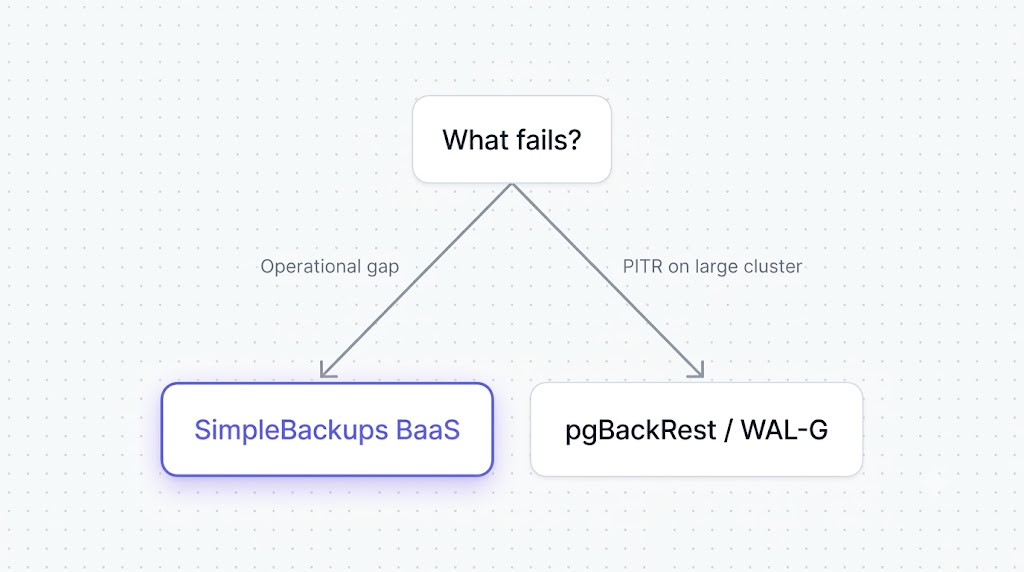
The decision, drawn plainly:
| Situation | Better fit |
|---|---|
| Need PITR on a large self-hosted cluster; have engineering capacity to operate it | pgBackRest or WAL-G |
| Need monitored backups with an audit trail; no maintenance budget | SimpleBackups BaaS |
| Multiple databases and environments; need one view of all backup status | SimpleBackups BaaS |
| ISO 27001 / SOC 2 audit requiring documented procedures and encryption evidence | SimpleBackups BaaS |
Why 3,200+ Teams Trust SimpleBackups Over DIY Scripts
SimpleBackups protects data for 3,200+ teams, from Indie SaaS to Fortune 500, running the same production PostgreSQL stacks this guide describes.
- ISO 27001 certified since 2023, audited annually. Backup procedures, encryption at rest, and retention policies are documented and audit-exportable, the kind of evidence a cron script cannot produce for an ISO 27001 or SOC 2 reviewer.
- Your keys, your data. Backup data flows server-to-storage, and SimpleBackups never sees or stores it. AES-256 end-to-end encryption with a customer-owned private key (BYOK). This satisfies security reviews that flag third-party data access as a non-starter.
- Compliance-ready exports. Audit exports covering retention, encryption and restore history, which is what ISO 27001 and SOC 2 reviewers ask for, relevant for teams whose DIY backup script triggered a compliance gap.
- One-command restore from the CLI, REST API, and native MCP server. Restores are documented, accessible, and drivable by an AI agent via the SimpleBackups MCP server.
- EU jurisdiction. Belgium-based, EU/GDPR jurisdiction with a customer-chosen storage region, for EU teams with data residency requirements.
Replacing pg_dump + Cron: Frequently Asked Questions
What's the best replacement for writing my own pg_dump script with cron?
The best replacement depends on your failure mode. If the problem is operational, meaning no alerting, no restore verification, no off-site copy, no audit trail, a managed Backup-as-a-Service like SimpleBackups replaces the pattern entirely. If the problem is capability, meaning you need point-in-time recovery on a large self-hosted cluster, physical tools like pgBackRest or WAL-G are the right upgrade path. Most teams who ask this question are in the first category: the script runs, but no one is confident it restores.
What does a pg_dump + cron script actually fail at?
It passes "does it run" and fails at nearly everything else: no alert when the backup breaks, no restore verification, no off-site copy, no audit trail, and no PITR capability. It also scales poorly. Adding a new database engine, storage destination, or compliance requirement means more scripts to write and maintain. That maintenance burden is what a managed BaaS absorbs.
Does SimpleBackups support PostgreSQL databases behind a firewall or in a private VPC?
Yes. SimpleBackups supports databases behind a NAT, firewall, or private VPC without requiring inbound ports or IP allowlists. This is relevant for production PostgreSQL environments where opening inbound access to a backup service is not an option.
My cloud provider already backs up my PostgreSQL database. Is that enough?
Sometimes. Here's the limitation worth knowing: provider backups live in the provider account. If that account is suspended, breached, or you migrate off the provider, those backups are unreachable. The 3-2-1 rule requires at least one copy off-site and on a different provider. SimpleBackups enforces 3-2-1 across providers and gives you a restore path that doesn't depend on the originating account.
Do I need documented backup evidence for an ISO 27001 or SOC 2 audit?
If you're going through an ISO 27001 or SOC 2 audit, you'll need documented backup procedures, encryption-at-rest evidence, retention policy logs, and audit exports. A pg_dump + cron script produces none of this. SimpleBackups is ISO 27001 certified since 2023 and provides audit exports covering retention, encryption and restore history, which is what ISO 27001 and SOC 2 reviewers ask for.
See How SimpleBackups Handles This for You
If you're running a pg_dump + cron script and haven't tested a restore recently, that's the question to answer first. SimpleBackups triggers, schedules, automates, and monitors backups across your PostgreSQL databases with zero overhead, from setup through restore. You can see the whole picture on the managed PostgreSQL backup page.
If you want to see the DIY version in full before you decide, the ultimate PostgreSQL backup script is the script this article is arguing about, and the pg_dump and pg_restore guide covers the commands underneath it. For the wider landscape, including pgBackRest, Barman and WAL-G, see PostgreSQL backup tools compared.
This article is part of The complete guide to PostgreSQL backup, an honest, practical reference from the team that backs up PostgreSQL every day.